Cowboy on Horseback Embroidery Review
First Impressions: Whimsy with Craftsmanship
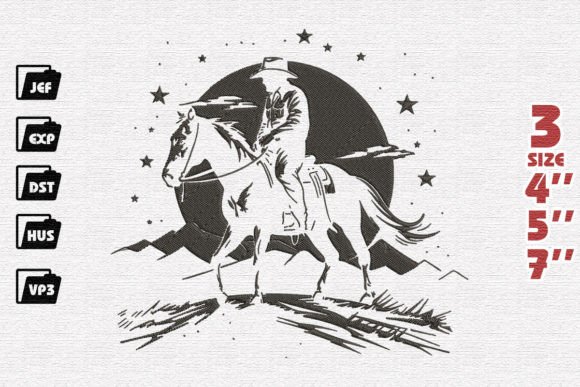
When I opened the Cowboy on Horseback embroidery file from Creative Fabrica, I wasn’t just scanning for stitch count—I was asking: *Does this feel like something my customers would proudly display on a handmade apron or gift-wrap in a boutique box?* The answer is yes. It’s got that warm, approachable charm—think tilted hat, relaxed posture, and a horse mid-stride—not stiff or overly cartoonish. As a designer who balances playfulness with precision, I appreciated how the silhouette reads clearly at small sizes, yet holds expressive detail in the brim, stirrups, and horse’s mane. It’s not an appliqué design; it’s a fully digitized machine embroidery design built around satin stitch outlines and thoughtful fill stitch gradients. That means texture without bulk—critical when stitching on lightweight cotton baby blankets or curved cap fronts.
Fits Real Projects—Not Just Mockups
I tested Cowboy on Horseback across six real product types: a linen tote bag, unisex sweatshirt, denim apron, kitchen towel, baby muslin blanket, and a twill baseball cap. On the tote and apron, it stitched cleanly with medium-weight cutaway stabilizer—no puckering, even where the fabric had subtle texture. The sweatshirt required a light tear-away + topping combo to keep the satin stitch crisp over fleece backing. Most surprisingly, it held up beautifully on the cap—thanks to balanced stitch density and minimal tiny details. There’s no micro-lettering or fragile thread loops, so no need to worry about breakage on stretchy or curved surfaces. That makes Cowboy on Horseback unusually versatile for commercial embroidery: it scales well, reads at arm’s length, and doesn’t demand specialty needles or ultra-slow speeds.
What Works—and What Needs Attention
The design shines brightest on medium-to-light fabrics: natural cotton towels, oatmeal-colored sweatshirts, ivory linen pillow covers. On dark fabric, contrast matters—test your thread colors early. I swapped default navy for a rich burnt umber on black denim and loved the warmth it added. That said, avoid using it on highly textured burlap or loosely woven canvas without heavy stabilizing—it’s not designed to bridge wide gaps. Also, while the horse’s legs and reins are defined, they’re not hyper-detailed. That’s intentional: this isn’t a museum-piece digitization. It’s a friendly, functional embroidery file meant to enhance—not dominate—a handmade product.
Small Hoop Friendly, But Verify Before You Stitch
I ran Cowboy on Horseback in a 4x4 hoop without resizing—and it fit comfortably with breathing room. That’s huge for small-batch sellers using compact machines. Still, always confirm the actual hoop size listed on the Creative Fabrica product page before committing to a production run. Some versions may include alternate sizes (5x7, 6x10), but unless stated, assume the base file targets standard entry-level hoops. If you plan to scale it down for baby onesies or patches, test first: fine lines can collapse below 3 inches wide, especially in satin-stitched brims or narrow reins.
Commercial Use & Customer Trust
As someone who sells embroidered goods on Etsy and supplies local boutiques, I pay close attention to how a design affects buyer perception. Cowboy on Horseback elevates a simple kitchen towel into a themed hostess gift. It adds narrative to a plain sweatshirt—making it feel curated, not mass-produced. That storytelling boosts perceived value and encourages repeat orders. I’ve seen customers specifically request “that friendly cowboy” after seeing it on a printable mockup in my shop gallery. Crucially, it maintains brand consistency across categories: same confident line weight on a patch, same clean fill on a pillow cover. No jarring shifts in density or proportion. That reliability builds trust—especially when buyers order personalized gifts and expect cohesive quality across items.
Practical Notes Every Designer Should Check
- Test on scrap fabric first—especially if stitching on terry cloth, fleece, or dark twill. Thread tension and stabilizer choice change everything.
- Review stitch density before running batches. Dense fills hold up to washing better—but too much density on thin fabric causes stiffness. This design strikes a smart middle ground.
- Confirm file formats and licensing on the Creative Fabrica product page. Not all embroidery files include commercial rights by default—even if described as “for t-shirts and home decor.” Read carefully before listing finished products.
- Use proper stabilizer: cutaway for knits and stretchy fabrics, tear-away for stable wovens, and topping for napped or fuzzy surfaces like towels.
- Inspect small details post-stitch: check the horse’s eye, boot stitching, and hat brim edge for skipped stitches or thread nests—especially on older machines.
- Compare light/dark fabric mockups before finalizing thread palettes. A single shade can look warm on cream and muddy on charcoal.
Where It Adds Quiet Value
You won’t find flashy gimmicks here—no blinking LEDs or 3D puff. Instead, Cowboy on Horseback delivers quiet value: ease of digitization, adaptability across product types, and emotional resonance. It works as a standalone motif on a cap, a focal point on a nursery pillow, or part of a coordinated set (e.g., matching towel + apron + baby blanket). For Etsy sellers, it’s a strong candidate for seasonal bundles—pair it with cactus silhouettes or vintage truck designs for Southwest-themed collections. For craft fair vendors, it photographs well under natural light and translates clearly in printed catalogs. And for apparel decorators building custom collections, it’s a low-risk, high-charm addition to your digital embroidery file library.
Final Thought: A Reliable, Human-Centered Design
In a marketplace flooded with overly complex or generic embroidery files, Cowboy on Horseback stands out because it respects both the machine and the maker. It doesn’t ask for perfection—just intention. It rewards careful thread selection, appropriate stabilizing, and thoughtful placement. Whether you’re stitching a personalized gift for a child’s birthday or producing 50 embroidered patches for a boutique launch, this design supports your process instead of complicating it. It’s not the flashiest Cowboy embroidery on Creative Fabrica—but it might be the most consistently useful.